A Feminist Companion to the Posthumanities by Cecilia Åsberg & Rosi Braidotti
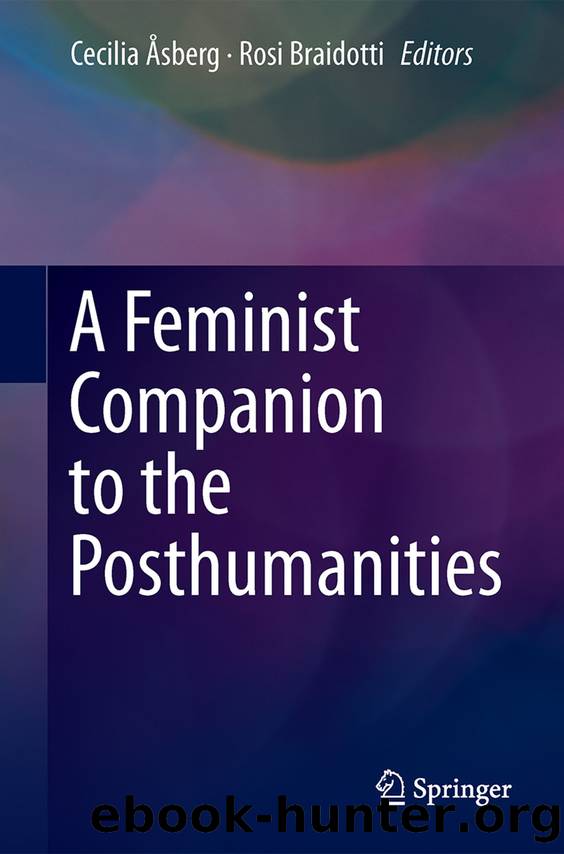
Author:Cecilia Åsberg & Rosi Braidotti
Language: eng
Format: epub
Publisher: Springer International Publishing, Cham
Identity Politics
Pivotal to understanding human/animal relations as intersectional, is to understand species as kin, in itself as relational (Charles 2014). Many of us live in multispecies households, raising questions about how sociality is constituted, and how categories are negotiated. Our relationships with animal companions are, moreover, freighted with ideas of gender and identity (for example, with horses: Birke and Brandt 2009). Here, we focus on one example where gender intersects with ideas of animality and family, around women and cats.
The phrase “cat lady” – title of a Canadian documentary (2008) – can invoke a lascivious, feline, image or it can imply someone who lives with many cats. The latter is often seen as lonely, ill or crazy, with a void filled by cats. Two contrasting woman/cat relationships emerge in the documentary. One is epitomized by Margot, who returns home from work to her three cats. Her apartment features cat portraits and show rosettes, and thus portrays her through her interspecies relationship. The cats appear well-groomed, content; Margot arrives and talks to them, so that they appear as her valued family. But only up to a point. Speaking of her lack of human friends, she says, sadly, “a lot of people don’t know, that I am as lonely as I am” (Cat Ladies 2008). For her loneliness, cats are inadequate substitutes.
The second example is epitomized by Diane and her 132 cats. They live, unsurprisingly, in chaos, some in cages, but many running around, behind furniture, or under beds. Diane, too, moves constantly, feeding, cleaning, giving medications. Recognizing that it has got out of hand, Diane says she must stop helping the cats and start thinking of herself; she appears to have lost control of her life, and the cats now control her. Like other “cat hoarders,” she is unable to care for her animals – or herself. Here, there are not only intersections of human-ness/femininity and animality/felinity, but representations are also intersected with age, social class and place (for extended discussion, see Holmberg 2015).
The film exploits several interspecies, intersectional identity markers. Diane is stressed, rushing around like her cats, but she is also portrayed as a victim of circumstances. Gender and class interact with this animaling process, so that Diane becomes a helpless woman in relation to the cats who take over. Margot, in contrast, appears as an inadequate woman who “mothers” cats instead of children. Moreover, the place called home looks very different in these two stories. Margot’s apartment seems feminine, intersecting with her cat mothering identity, while Diane’s chaotic house is dominated by the lives of the cats, producing a troublesome identity – a woman without a home, yet not homeless.
When these cat ladies appear as home bound, irrational and out of control, they seem to lose something of their human status. And if they lose humanness because of their lack of conspecific relationships, the cats lose their pet-ness. Hissing cats in cages conflict with ideas of domesticated, docile pussycats. But even the human-made, babied cat breaks with the ideal image of the pet.
Download
This site does not store any files on its server. We only index and link to content provided by other sites. Please contact the content providers to delete copyright contents if any and email us, we'll remove relevant links or contents immediately.
| Anthropology | Archaeology |
| Philosophy | Politics & Government |
| Social Sciences | Sociology |
| Women's Studies |
The remains of the day by Kazuo Ishiguro(9222)
Tools of Titans by Timothy Ferriss(8594)
Giovanni's Room by James Baldwin(7550)
The Black Swan by Nassim Nicholas Taleb(7275)
Inner Engineering: A Yogi's Guide to Joy by Sadhguru(6890)
The Way of Zen by Alan W. Watts(6733)
The Power of Now: A Guide to Spiritual Enlightenment by Eckhart Tolle(5924)
Asking the Right Questions: A Guide to Critical Thinking by M. Neil Browne & Stuart M. Keeley(5897)
The Six Wives Of Henry VIII (WOMEN IN HISTORY) by Fraser Antonia(5608)
Astrophysics for People in a Hurry by Neil DeGrasse Tyson(5276)
Housekeeping by Marilynne Robinson(4583)
Double Down (Diary of a Wimpy Kid Book 11) by Jeff Kinney(4408)
Ikigai by Héctor García & Francesc Miralles(4390)
Skin in the Game by Nassim Nicholas Taleb(4382)
12 Rules for Life by Jordan B. Peterson(4376)
The Ethical Slut by Janet W. Hardy(4350)
The Art of Happiness by The Dalai Lama(4232)
Skin in the Game: Hidden Asymmetries in Daily Life by Nassim Nicholas Taleb(4126)
Walking by Henry David Thoreau(4076)
